

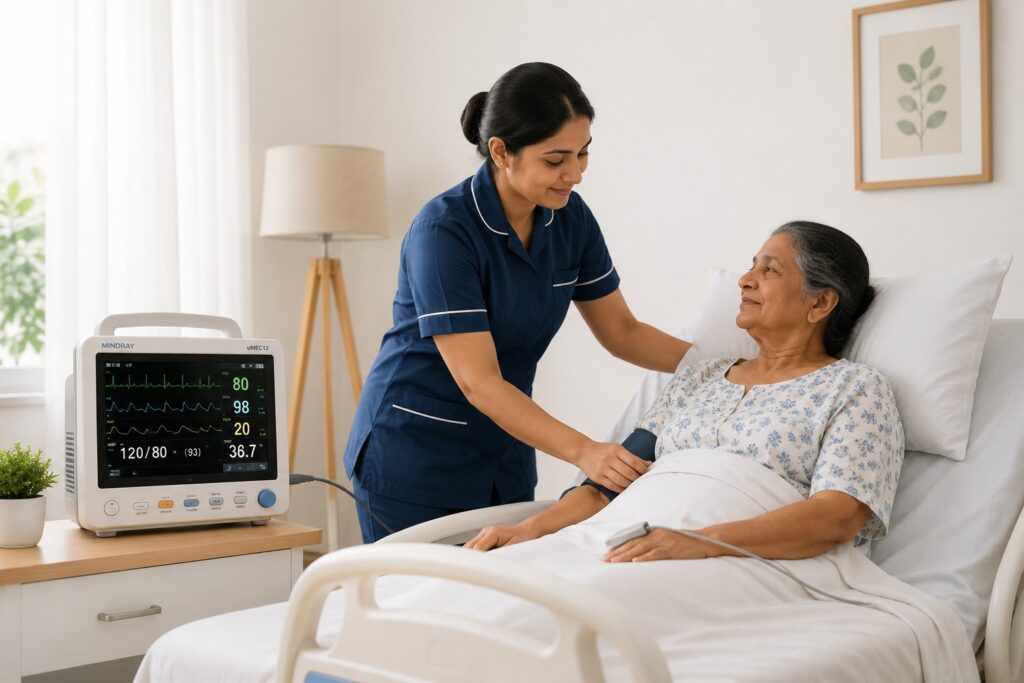
When transitioning a critically ill parent from a highly monitored hospital ward back to their own bedroom, families often feel a deep sense of anxiety. In the hospital, doctors always knew exactly how the patient was doing because the electronic screens constantly beeped and displayed bright numbers. At home, family members can only look at the patient’s face, touch their forehead, or try to guess their heart rate by holding their wrist. But simply looking at a sick patient is never enough to know what is actually happening inside their body. A sudden, dangerous drop in blood oxygen or a massive spike in blood pressure can happen completely silently.
To bridge this massive clinical gap, a multipara patient monitor acts as the central electronic brain of any professional home ICU setup. This is the exact same clinical-grade tracking screen you see beside beds in hospital critical care units.
What does a multipara monitor actually track — and why do we need all of it?
A standard 5-parameter monitor tracks the most vital functions of human survival continuously in real-time. It actively records the electrocardiogram (ECG) to watch the heart’s electrical rhythm, uses a glowing finger probe to track blood oxygen levels (SpO2), automatically inflates a cuff every few hours to measure blood pressure, counts the exact number of breaths the patient takes per minute, and constantly reads the patient’s body surface temperature.
Because this machine provides heavy clinical data, simply having the monitor in the room is entirely useless without a trained professional to interpret it. Applying sticky ECG electrode patches to the patient’s bare chest and understanding the complex waves requires deep medical knowledge. This is exactly why a multipara monitor must be operated exclusively by a qualified, freelance home-care nurse or the attending physician.
Can a family member operate the patient monitor without a nurse present?
While the bright screen is easy to look at, interpreting complex ECG waves and responding to sudden vital sign crashes requires specialised medical training. It should strictly be used under a professional nurse’s supervision. Having the monitor without the nurse is like having a flight cockpit without a pilot — the data is only as useful as the person reading it.
Managing a critically ill patient at home means coordinating medicines, equipment, nursing, and consumables — often from multiple unreliable vendors. Hospit eliminates that burden entirely. From same-day medical equipment delivery and rental to pharmacy, nursing, caretaker support, and Comprehensive Geriatric Assessment — everything comes from one number, one team, and one invoice. Call us or WhatsApp us today to tell us what your loved one needs.
How does the monitor actually protect our loved one while everyone is asleep at night?
The true power of the monitor lies in its alarm system. The home nurse will manually program specific high and low safety limits for your parent’s blood pressure and heart rate into the machine’s computer based on the discharge summary. If the patient’s oxygen drops dangerously low while they are sleeping, the monitor will instantly flash red and sound a loud, sharp alarm, immediately waking the nurse so they can administer emergency oxygen or medical care long before the family even realises something is wrong.
What happens to the monitor during a power cut — does it stop working?
The monitor contains a small internal battery that usually lasts for one or two hours, which is perfect for hospital transit or a sudden power cut. However, for continuous home monitoring, it must remain plugged into your wall outlet. In areas with frequent outages, pairing the monitor with a small UPS or inverter backup is a sensible precaution worth discussing with your equipment provider.Do we need to buy the blood pressure cuff and finger sensors separately, or are they included?
No. All standard, reusable clinical sensors — like the blood pressure cuff, temperature wire, and oxygen finger probe — are fully included with the monthly rental of the machine. Only the disposable sticky ECG chest patches need to be purchased separately. Budgeting for a steady supply of ECG patches is a small but important detail that families often overlook until the first set runs out.You should not have to act as a hospital administrator while also being a son, daughter, or spouse. Hospit handles the medicines, the equipment, the nurses, the consumables, and the coordination — so you can focus on being present for your loved one. Tell us what your loved one needs and we will take it from there. Call us or WhatsApp us today.