

When an elderly parent finally transitions to a home ICU setup after a paralysing stroke or a major hip replacement surgery, families usually focus all their daily attention on feeding them soft foods and giving them their painkillers on time. Since the patient is strictly told by the surgeon to rest continuously in bed, the family naturally assumes they are perfectly safe. However, prolonged bed rest hides a silent, invisible, and highly dangerous threat deep inside the patient’s legs, known in the medical world as deep vein thrombosis.
What is this hidden danger of bed rest that nobody warns you about?
Every single time you walk around your house, the physical squeezing motion of your heavy calf muscles acts exactly like a natural pump, pushing your blood continuously upward against gravity and back to your heart. When a sick patient lies completely still in a hospital bed for days or weeks on end, that natural muscle pumping stops entirely. The thick blood in their lower legs begins to pool and stagnate. This stagnant blood can slowly form a solid, dangerous blood clot deep inside the vein. If a tiny piece of this clot breaks off and travels rapidly through the bloodstream to the lungs, it can cause a sudden, fatal medical emergency called a pulmonary embolism.
To completely prevent this life-threatening risk, top orthopaedic surgeons and critical care doctors strongly prescribe the daily use of an intermittent pneumatic compression device, which is commonly called a DVT pump.
How long does the patient actually need to wear the DVT pump sleeves every day?
This must be strictly decided by your treating doctor or surgeon. Some surgical patients are required to wear them continuously for 24 hours a day, removing them only for quick bathing, while others may only need them at night. Never adjust the schedule on your own — the duration is part of the clinical prescription, not a general guideline.
Managing a critically ill patient at home means coordinating medicines, equipment, nursing, and consumables — often from multiple unreliable vendors. Hospit eliminates that burden entirely. From same-day medical equipment delivery and rental to pharmacy, nursing, caretaker support, and Comprehensive Geriatric Assessment — everything comes from one number, one team, and one invoice. Call us or WhatsApp us today to tell us what your loved one needs.
So how exactly does a DVT pump protect a bedridden patient?
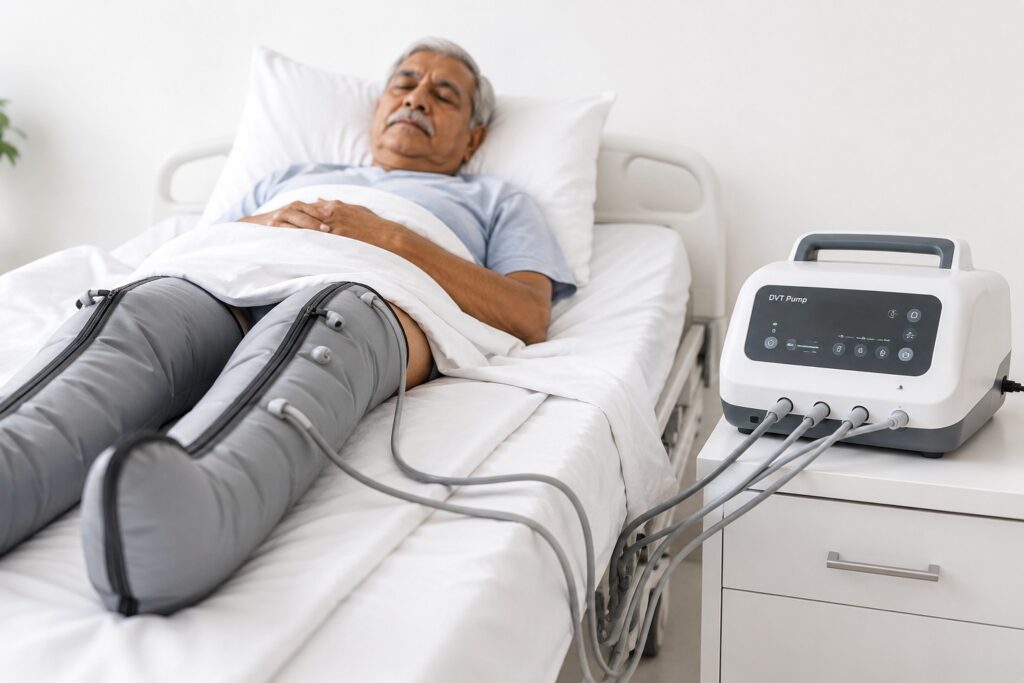
A DVT pump is a simple, quiet medical machine that solves the dangerous problem of physical immobility. The home caregiver wraps soft, inflatable fabric sleeves snugly around the patient’s bare calves or thighs. The pump then systematically inflates these sleeves with air, creating a firm, squeezing pressure on the legs, before slowly deflating them. This rhythmic squeezing perfectly mimics the natural muscle contractions of walking. It forces the pooled blood to keep circulating vigorously back toward the heart, actively stopping any dangerous clots from ever forming while the patient rests safely in their bed.
Because the inflatable sleeves wrap very tightly against the patient’s skin for hours at a time, personal hygiene is absolutely critical. Reusing old, sweaty fabric sleeves shared by previous patients can easily lead to severe skin rashes or infections. This is exactly why it is highly recommended to purchase a brand-new, freshly sealed pair of compression sleeves specifically for your loved one, even if you are only renting the main electronic pump machine for a few short weeks.
Does the squeezing actually hurt? Will it disturb the patient’s sleep?
Not at all. The air inflation pressure is clinically calibrated to be very gentle and soothing. Most patients find the rhythmic squeezing actually feels like a light leg massage and sleep very comfortably through it. For an already exhausted family, knowing that a piece of equipment is quietly protecting their loved one through the night — without causing any discomfort — is a genuine relief.
Can the patient get up and walk to the bathroom while wearing the sleeves?
No. The patient must never attempt to stand or walk while the plastic air tubes are connected to the machine, as this is a severe tripping hazard and could cause a highly dangerous fall. The sleeves must always be disconnected and removed before the patient attempts any movement, however short.
You should not have to act as a hospital administrator while also being a son, daughter, or spouse. Hospit handles the medicines, the equipment, the nurses, the consumables, and the coordination — so you can focus on being present for your loved one. Tell us what your loved one needs and we will take it from there. Call us or WhatsApp us today.