

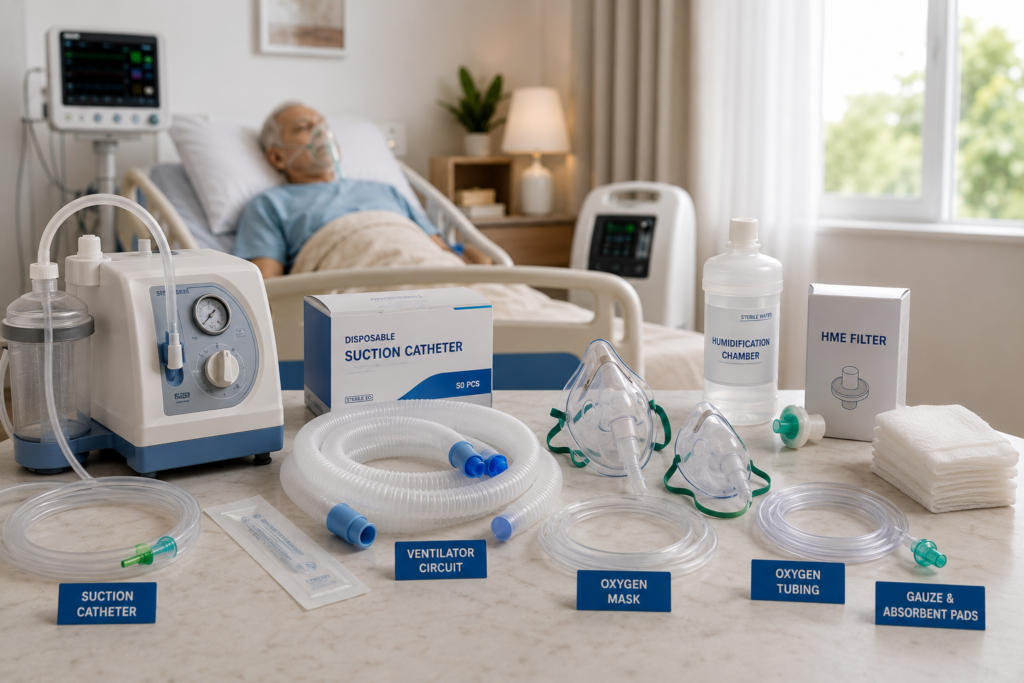
When a patient comes home with severe lung issues or a tracheostomy tube inserted in their neck, watching them struggle to breathe can be incredibly frightening for the family. In these delicate situations, maintaining a clear and open airway is a matter of life and death. The heavy machines like oxygen concentrators and suction motors do the heavy lifting, but they are entirely useless without the correct, clean plastic attachments. These small, often ignored items are some of the most critical daily medical consumables in any home care setup, and managing them properly prevents terrible lung infections.
How does oxygen actually reach the patient’s lungs — and why do those plastic tubes need to be replaced so often?
The oxygen machine pulls air from the room, but it needs a clean pathway to reach the patient’s lungs. This is done using thin plastic nasal prongs that sit inside the nose, or a soft plastic oxygen face mask. Because the patient is breathing into these plastics all day and night, moisture quickly builds up inside the tubes. This warm moisture is a perfect breeding ground for dangerous bacteria. If you use the same dirty oxygen mask for a month, the patient will inhale that bacteria directly into their weak lungs, often leading to a severe case of pneumonia. Doctors strongly recommend replacing these simple masks and tubes every few days to keep the air perfectly clean.
How often should we change the oxygen mask or nasal tube?
As a general rule of thumb, you should replace the nasal prongs or oxygen mask every one to two weeks, or immediately if they look visibly dirty, stiff, or filled with hard water droplets. When in doubt, replace early — a fresh nasal prong costs a fraction of what treating a preventable lung infection does.
Why does the oxygen concentrator have a small water bottle attached to it?
That plastic bottle is called a humidifier. It bubbles the dry oxygen through sterile water to add moisture, preventing the patient’s nose and throat from becoming painfully dry and bleeding. The water in this humidifier bottle must also be replaced regularly with distilled or clean RO water — allowing it to run dry or become stagnant defeats its purpose entirely.
Managing a critically ill patient at home means coordinating medicines, equipment, nursing, and consumables — often from multiple unreliable vendors. Hospit eliminates that burden entirely. From same-day medical equipment delivery and rental to pharmacy, nursing, caretaker support, and Comprehensive Geriatric Assessment — everything comes from one number, one team, and one invoice. Call us or WhatsApp us today to tell us what your loved one needs.
Why is it so dangerous to reuse a suction catheter — even if it has been washed?
The thin plastic tube that actually goes down the patient’s throat, known as a suction catheter, must be strictly sterile. A home care nurse might need to suction a patient ten times a day, which means the family needs a massive stock of individually wrapped, sterile suction catheters. A very dangerous mistake that families make when they run low on supplies is asking the nurse to wash a used catheter with hot water and soap to reuse it later. This invisible household bacteria gets pushed straight into the patient’s lungs on the next use. You must always throw away the catheter immediately after a single use. Stocking out is never a good enough reason to reuse — it is always cheaper to order more catheters than to treat a new lung infection.
What size suction catheter should we buy — does it matter?
Suction catheters come in various colour-coded sizes, indicating their thickness. Your doctor or treating nurse will strictly specify the correct size on the discharge summary based on the patient’s exact airway needs. Never substitute a different size based on availability — the wrong catheter size can either be too traumatic for the airway or too thin to clear thick mucus effectively.
What about nebuliser supplies — do those plastic cups and masks need replacing too?
If your loved one uses a nebuliser machine to take inhaled asthma or COPD medications, the small plastic medicine cup and mask must be replaced frequently. The tiny holes in the nebuliser cup can get easily clogged with dried medicine over time, completely ruining the effectiveness of the costly drugs. Keeping a dedicated, neatly organised drawer full of fresh respiratory plastics ensures that whenever the patient is gasping for air or choking on mucus, the nurse has exactly what she needs to help them instantly — without a moment of panicked searching.
You should not have to act as a hospital administrator while also being a son, daughter, or spouse. Hospit handles the medicines, the equipment, the nurses, the consumables, and the coordination — so you can focus on being present for your loved one. Tell us what your loved one needs and we will take it from there. Call us or WhatsApp us today.