

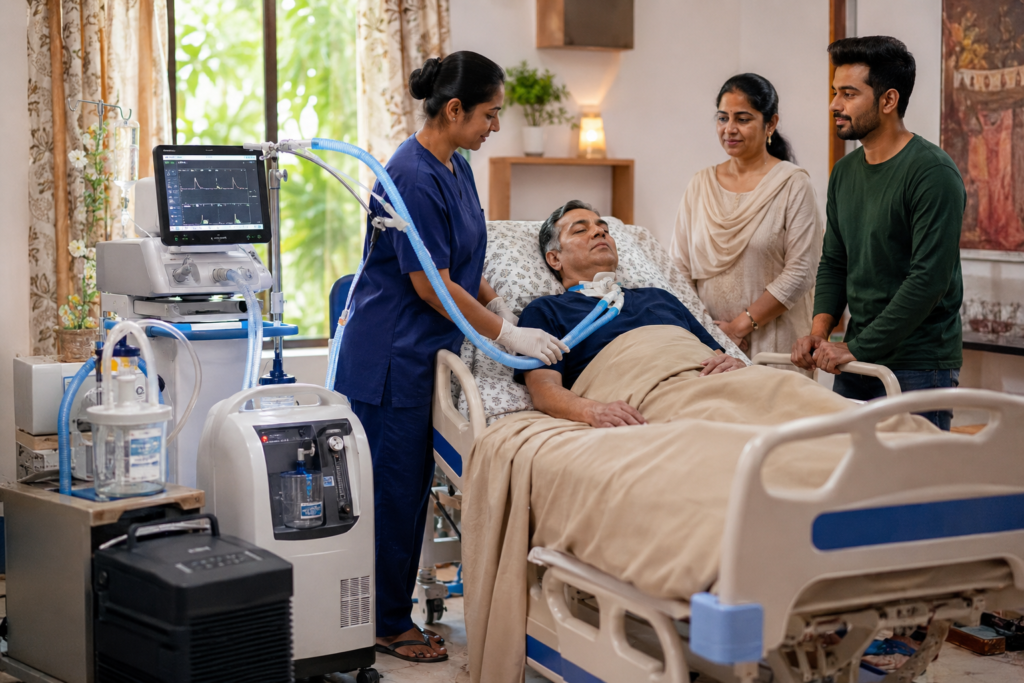
When a critically ill patient is finally discharged from the intensive care unit after a prolonged hospital stay, Indian families are often flooded with relief. Their loved one is “stable enough to come home.” However, for some patients — those recovering from a massive brain injury, severe Guillain-Barré syndrome, or advanced respiratory failure — “stable” does not mean “breathing independently.” For these patients, the treating physician will send them home connected to a mechanical ventilator, a machine that takes over the entire work of breathing as part of a comprehensive Home ICU setup.
For most Indian families, this is the moment the real panic sets in. The word “ventilator” carries enormous weight in Indian households. Most people associate it only with the final days of a terminal illness. That fear is deeply understandable, but it is also deeply inaccurate.
A ventilator is a tool. Used correctly at home, under the supervision of a critical care-trained nurse and within a properly managed Home ICU setup, it allows a patient to live with real dignity in their own bedroom rather than spending months in an expensive hospital ICU. The first step to managing this situation well is to understand, clearly and calmly, what the machine actually does.
What does a home ventilator actually do — and is it really only for patients who are dying?
Every time a healthy person breathes, the diaphragm — the large dome-shaped muscle beneath the lungs — contracts and pulls the chest cavity open. This drop in pressure draws fresh air in. When the diaphragm relaxes, the lungs deflate and push stale air back out. In patients with severe neurological damage, full paralysis, or end-stage lung disease, this muscular mechanism fails completely. The ventilator replaces it.
A home mechanical ventilator connects to the patient through a breathing circuit — a set of plastic tubes and valves. In most home setups, this circuit attaches either to a tight-fitting mask covering the nose and mouth, which is called non-invasive ventilation, or to a tracheostomy tube inserted directly into the patient’s neck, which is called invasive ventilation. The machine then delivers precisely measured breaths at a set rate, pressure, and volume — exactly as prescribed by the pulmonologist or intensivist. The patient’s lungs inflate, rest, and deflate in a safe, consistent rhythm controlled entirely by the machine’s internal computer, not the patient’s failing muscles.
What is the difference between non-invasive and invasive ventilation?
Families often hear both terms and confuse them. Non-invasive ventilation, or NIV, means the machine delivers pressurised air through a tightly sealed mask. The patient still breathes through their own nose and mouth — the machine simply assists and amplifies each breath. This is the gentler option and is common for patients with severe COPD exacerbations or neuromuscular diseases where the breathing muscles are weak but the airway itself is fully intact.
Invasive mechanical ventilation means the patient has a tracheostomy — a surgically created opening in the front of the neck with a plastic tube inserted directly into the windpipe. The ventilator connects to this tube, bypassing the nose and mouth entirely. This is necessary for patients with no meaningful breathing effort of their own, or those whose upper airway cannot be safely kept open. Tracheostomy care at home is detailed and demanding work, but thousands of Indian families manage it successfully every day with the right training and the right nurse.
Can a patient on a home ventilator ever be weaned off the machine completely?
Yes, absolutely, for many patients. The treating pulmonologist will periodically assess the patient’s respiratory muscle strength and may prescribe formal weaning trials — carefully planned short periods where the ventilator support is gradually reduced to encourage the patient’s own muscles to work again. This process requires very careful medical supervision and should never be attempted at home without explicit, written guidance from the doctor. The possibility of weaning is one more reason why a home ventilator setup, managed well, is genuinely a bridge toward recovery for many patients — not just an end-of-life measure.
Managing a critically ill patient at home means coordinating medicines, equipment, nursing, and consumables — often from multiple unreliable vendors. Hospit eliminates that burden entirely. From same-day medical equipment delivery and rental to pharmacy, nursing, caretaker support, and Comprehensive Geriatric Assessment — everything comes from one number, one team, and one invoice. Call us or WhatsApp us today to tell us what your loved one needs.
What does it actually take to make home ventilator care genuinely safe?
A ventilator sitting in a bedroom is not inherently dangerous. What makes the difference between safe care and a catastrophe is the ecosystem built around the machine. A home ventilator setup requires several non-negotiable elements working together.
The first is a trained critical care nurse present at all times, in proper shifts. This nurse must be able to read the machine’s alarm codes, clear a blocked tracheostomy tube using a suction machine, change the breathing circuit hygienically, and escalate to the treating physician immediately if any parameter changes unexpectedly. A general-duty nurse without ICU training is not sufficient for a ventilated patient.
The second is an uninterrupted power supply. A ventilator that runs on mains power and suddenly trips off during load shedding is a medical emergency within seconds. Every home ventilator setup must include a high-capacity inverter or UPS with enough battery backup to sustain the machine through a full power cut until electricity is restored or an emergency team arrives. This is not optional infrastructure — it is as important as the machine itself.
The third is a family member who has been specifically trained in the basics. They do not need to understand the clinical settings, but they must know how to silence an alarm, how to manually inflate the patient’s lungs using an Ambu bag if the machine fails, and exactly when to call the nurse and the doctor immediately.
Is it safe to use a home ventilator during Mumbai’s frequent power cuts?
Yes, provided the home has an adequate inverter or UPS system with a battery capacity matched specifically to the ventilator’s power draw. A technical team should evaluate this at the time of installation and recommend the correct backup configuration for your specific building and locality. Never assume the standard home inverter you use for fans and lights is sufficient — a ventilator’s power requirements must be assessed separately.
What do those ventilator alarms actually mean — and should the family panic when they go off?
Ventilators continuously monitor the patient’s breathing and sound an alert when something is wrong. New families often find this frightening, but learning the two most common alarms immediately reduces panic enormously.
A high-pressure alarm usually means the patient has coughed, the breathing circuit has kinked somewhere, or thick mucus is partially blocking the tube. The nurse addresses this by suctioning the airway using the suction machine or gently straightening and repositioning the circuit. A low-pressure alarm typically means the breathing circuit has come disconnected — the mask has shifted off the face, or a tube joint has accidentally pulled apart. This is corrected in seconds by firmly reconnecting the circuit.
Understanding that alarms are normal, expected events — not crises — helps the family remain calm and allows the nurse to do her job quickly and efficiently every single time.
What happens if the ventilator develops a technical fault in the middle of the night?
A reliable rental provider guarantees immediate replacement of any faulty machine. Until the replacement unit arrives, the family nurse must manually ventilate the patient using a self-inflating Ambu bag, which must always be kept at the bedside as a mandatory emergency backup. Never keep a ventilated patient at home without an Ambu bag in the room. This one precaution — simple, inexpensive, and non-negotiable — can be the difference between a manageable emergency and a tragedy.
You should not have to act as a hospital administrator while also being a son, daughter, or spouse. Hospit handles the medicines, the equipment, the nurses, the consumables, and the coordination — so you can focus on being present for your loved one. Tell us what your loved one needs and we will take it from there. Call us or WhatsApp us today.