

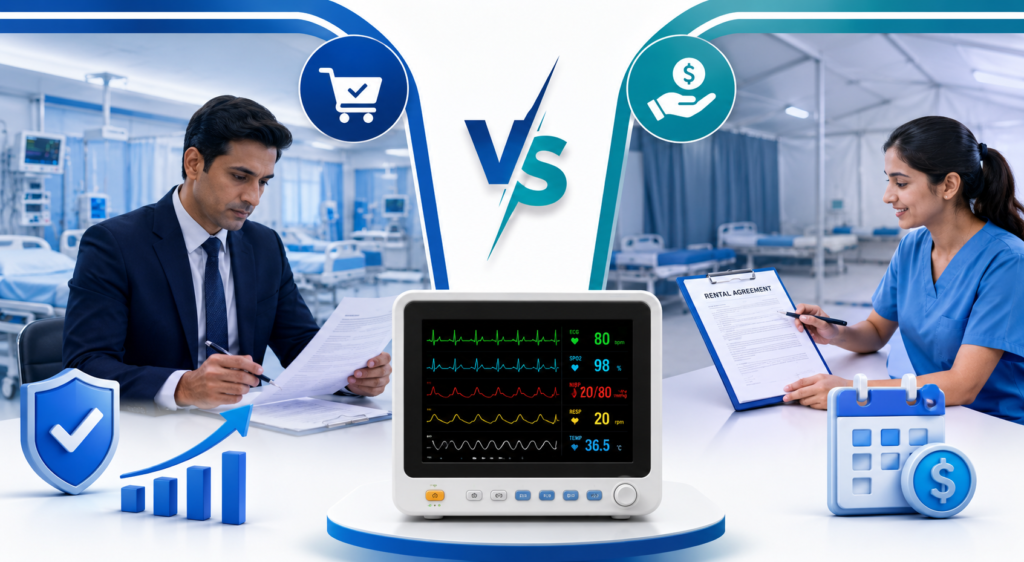
When a family decides to bring a critically ill patient home from the hospital to set up a home intensive care unit, the room quickly fills up with advanced technology. The most intimidating piece of machinery is often the multipara patient monitor. This is the glowing screen sitting next to the bed, constantly beeping and displaying squiggly lines that track the patient’s heart rate, oxygen levels, blood pressure, and breathing rate. It acts as the ultimate digital watchdog for your loved one. Because these advanced monitors are incredibly expensive, deciding whether to buy or rent becomes a major topic of discussion. To make a smart choice, families must look closely at four specific criteria.
How long will our loved one actually need the monitor — and does that answer the rent-versus-buy question?
The first and most obvious criteria is the duration of the critical care. If your loved one has been brought home for a short step-down recovery after a severe heart attack or a major complicated surgery, they might only need strict monitoring for a few weeks until they stabilise. In these short-term recovery phases, renting a multipara monitor is incredibly cost-effective. You get hospital-grade monitoring at a fraction of the cost, and the machine is simply returned when the danger has passed. However, if the patient is in a permanent comatose state or suffering from a terminal illness that requires round-the-clock monitoring for years, buying the monitor outright might eventually become cheaper than paying a high rental fee every single month.
What does a five-para monitor actually measure — do we really need all of it?
A standard five-para monitor continuously measures five vital signs: the electrical activity of the heart, the oxygen saturation in the blood, the non-invasive blood pressure, the breathing rate, and the body temperature. Each parameter serves a distinct clinical purpose, and together they give the home-care nurse a complete, real-time picture of the patient’s internal condition — the kind of picture that simply cannot be obtained by observation alone.
Who pays when the oxygen probe wire breaks or the blood pressure cuff wears out?
A multipara monitor is a highly sensitive computer. It relies on expensive, fragile accessories like the finger oxygen probe, the sticky electrocardiogram wires, and the automated blood pressure cuff. These delicate wires easily break or wear out with daily use. If you own the machine, replacing a single broken oxygen probe can cost thousands of rupees. When you rent from a professional agency, the replacement of these faulty wires and the regular technical calibration of the machine are completely covered by the provider. For a device with this many fragile consumable parts, the maintenance argument for renting is particularly strong.
Managing a critically ill patient at home means coordinating medicines, equipment, nursing, and consumables — often from multiple unreliable vendors. Hospit eliminates that burden entirely. From same-day medical equipment delivery and rental to pharmacy, nursing, caretaker support, and Comprehensive Geriatric Assessment — everything comes from one number, one team, and one invoice. Call us or WhatsApp us today to tell us what your loved one needs.
The monitor was in another sick person’s home — is that a hygiene risk for our loved one?
Families often worry about cross-infection from a screen that was in another sick person’s house. While this fear is valid, it is completely managed by professional providers. The monitor itself is thoroughly wiped down with strong chemical disinfectants. More importantly, the sticky pads that attach to the patient’s chest are always brand new, disposable items, and the blood pressure cuffs are deeply sanitised, ensuring the highest level of infection control for your loved one. As with all rented equipment, the rule is simple: the machine is cleaned, the parts that touch the patient are always fresh.
Will the monitor beep constantly and disturb the patient’s sleep?
Monitors do have safety alarms, but a home care nurse or technician will carefully set the upper and lower limits based on the doctor’s advice, so it only beeps when there is an actual medical concern. Properly configured alarm limits are one of the most important setup steps — insist that the nurse programmes them from the discharge summary on the very first day, rather than leaving the machine on default factory settings.
Does a family member need medical training to read the monitor, or can anyone use it?
While a family member can easily learn to read the basic numbers like heart rate and oxygen saturation, it is highly recommended to have a trained home care nurse who can correctly interpret the complicated heart tracing lines. The numbers are readable by anyone; the ECG waveform is a different matter entirely, and a misread tracing in a critical moment is far more dangerous than not reading it at all.
What if a newer, smarter monitor with better alarms becomes available — are we stuck with the old one?
Hospital monitors are constantly upgrading with larger touch screens, wireless capabilities, and smarter alarm systems that do not beep unnecessarily. If you spend a fortune buying a heavy, older model today, you are permanently stuck with it. Renting allows your family the flexibility to upgrade to a newer, smarter monitor, ensuring that your home ICU setup always features the safest and most advanced technology available. For families managing a long-term critical care situation, this ability to stay current without repeated large expenditure is a genuine advantage.
You should not have to act as a hospital administrator while also being a son, daughter, or spouse. Hospit handles the medicines, the equipment, the nurses, the consumables, and the coordination — so you can focus on being present for your loved one. Tell us what your loved one needs and we will take it from there. Call us or WhatsApp us today.