

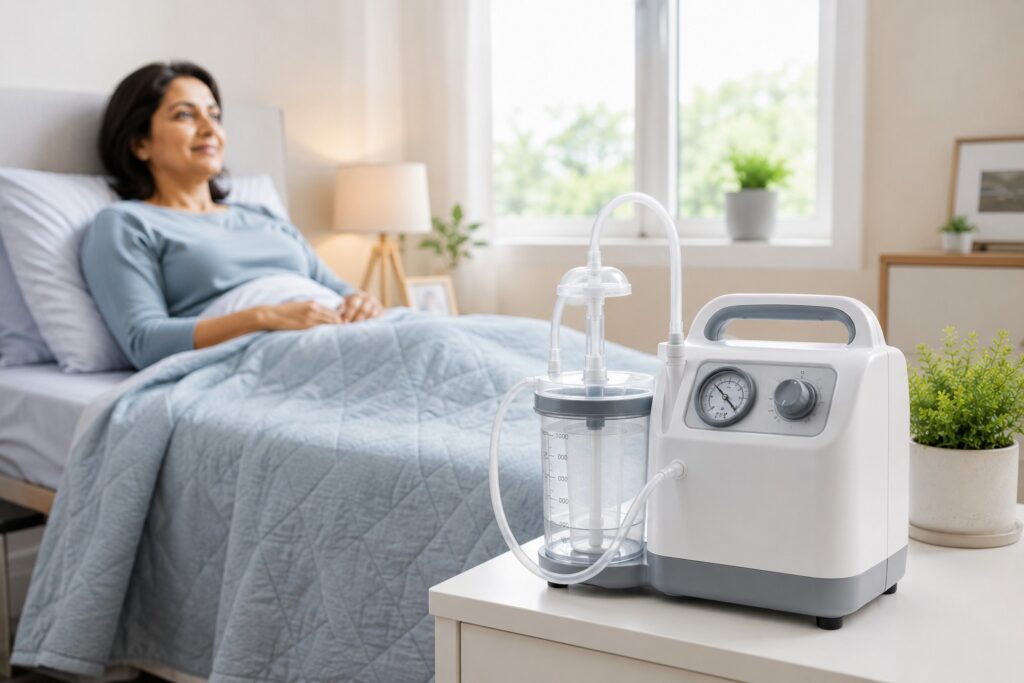
When a patient is brought home after a severe stroke, a long stay in the intensive care unit, or a major throat surgery, they often lose the natural ability to cough and clear their own throat. In these frightening situations, the doctor will prescribe a medical suction machine. This small but powerful device uses a vacuum pump to safely remove thick mucus, saliva, and secretions from the patient’s airway, quite literally saving them from choking. Because this machine is absolutely critical for the patient’s survival, families face a tremendous amount of stress when figuring out whether to buy or rent. To decide what is best for your loved one, you must carefully weigh four essential criteria.
How long will our loved one actually need the suction machine — does that settle the decision?
The first criteria is the expected duration of the medical problem. If your family member has a temporary tracheostomy tube inserted after a throat surgery, their airway will eventually heal, and the tube will be removed in a few weeks. In this temporary phase, renting a suction machine is the absolute smartest financial move. You get the critical life-saving support you need without spending thousands of rupees on a device that will soon become completely useless. Conversely, if you are caring for a patient with permanent paralysis or a severe neurological disease, they will unfortunately struggle with clearing secretions for the rest of their life. For such long-term home care, buying a reliable suction machine upfront is a much wiser, cheaper investment.
What happens if the motor fails in the middle of the night while the patient is choking?
The second criteria is the terrifying prospect of maintenance and sudden breakdowns. A suction machine relies on a strong internal motor to generate vacuum pressure. If that motor suddenly fails in the middle of the night while the patient is choking on phlegm, it is a massive medical emergency. If you buy the machine, you are entirely responsible for figuring out how to fix it immediately. When you rent a machine from a reliable medical provider, they guarantee quick replacements for broken machines, taking that immense burden of panic off your shoulders. For a device this critical, knowing that a replacement is one phone call away is not a small comfort — it is a clinical necessity.
Is a suction machine difficult for a family member to learn to use?
It looks intimidating, but a home care nurse or a doctor can easily teach a family member how to safely operate the machine, adjust the pressure dial, and gently clear the patient’s airway. The key is to get a proper hands-on demonstration at the time of delivery — do not accept a machine that arrives without a full operating walkthrough from the delivery technician.
Managing a critically ill patient at home means coordinating medicines, equipment, nursing, and consumables — often from multiple unreliable vendors. Hospit eliminates that burden entirely. From same-day medical equipment delivery and rental to pharmacy, nursing, caretaker support, and Comprehensive Geriatric Assessment — everything comes from one number, one team, and one invoice. Call us or WhatsApp us today to tell us what your loved one needs.
The machine handles bodily fluids — is it really hygienic to use a rented one?
Given that a suction machine handles bodily fluids and mucus, many Indian families find the idea of renting one slightly horrifying. It is completely understandable to want a brand new machine. However, it is important to know how these rentals actually work. The base motor is the only part that is reused, and it is heavily fumigated. The actual collection jars can be thoroughly sterilised, and the connecting tubes and suction catheters that actually touch the patient’s bodily fluids are always strictly purchased brand new and factory sealed. The machine is shared; the parts that matter most are always yours alone.
How often does the collection jar need to be cleaned — and what happens if we skip it?
The collection jar must be emptied and thoroughly washed with warm soapy water and a mild disinfectant after every single use to prevent dangerous bacteria from growing in the room. Skipping even one cleaning cycle allows infectious secretions to sit and multiply at room temperature — in a bedroom where a vulnerable patient is already breathing with compromised lungs, that is a risk no family should take.
Do the suction catheters need to be replaced after each use, or can they be reused?
No, the thin suction catheters that go into the patient’s mouth or throat are strictly single-use, disposable items to prevent severe lung infections. Stocking a generous supply of the correct French gauge size at home at all times is essential — running out of catheters during a choking episode is an entirely avoidable emergency that careful planning eliminates completely.
What if a quieter, more modern machine becomes available — are we locked into the old one?
Older suction machines can sound like loud, rattling diesel generators, which can be very disturbing for a sleeping patient. Modern machines are becoming significantly quieter, lighter, and feature better battery backups for power cuts. Renting gives you the flexibility to easily upgrade from a noisy older model to a silent, modern machine without having to purchase a completely new unit. For a patient who needs suctioning through the night, the difference between a rattling machine and a quiet one is the difference between broken sleep and genuine rest.
You should not have to act as a hospital administrator while also being a son, daughter, or spouse. Hospit handles the medicines, the equipment, the nurses, the consumables, and the coordination — so you can focus on being present for your loved one. Tell us what your loved one needs and we will take it from there. Call us or WhatsApp us today.