

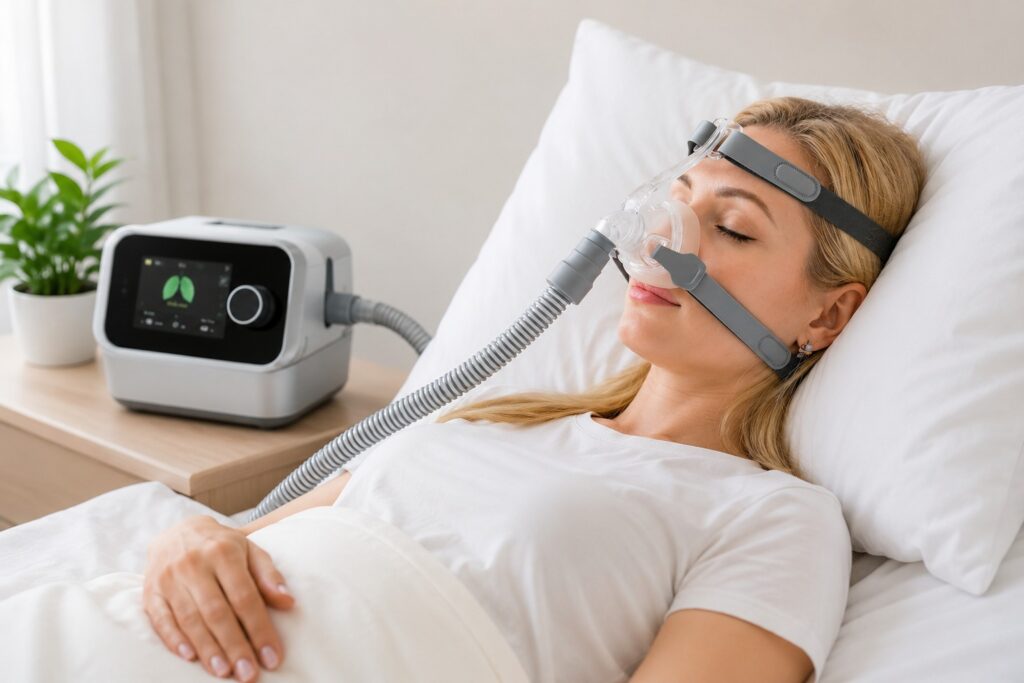
Decades of smoking beedis or cigarettes, or long-term exposure to heavy city pollution, often catches up with our elderly parents in their later years. A simple chronic cough slowly turns into severe breathlessness, even when just walking to the bathroom. This is the harsh reality of chronic obstructive pulmonary disease (COPD). When an elderly grandfather suffers a severe COPD flare-up, he often ends up in the hospital struggling for air. Once he is finally stabilised, the lung specialist will write a discharge summary ordering the family to arrange a home ICU setup that specifically includes a BiPAP machine to keep his lungs safe and functioning properly.
What does COPD actually do to the lungs — and why is it so exhausting for the patient?
To understand why a BiPAP machine is so critical, we have to understand what COPD actually does to the human body. In healthy lungs, the tiny air sacs act like stretchy rubber bands — they expand easily when you breathe in, and snap back tightly to push the stale air out. In a patient with severe COPD, these lungs lose all their natural elasticity. They become floppy and weak. While the patient can still breathe oxygen in, their lungs are too weak to forcefully push the stale air out. As a result, toxic carbon dioxide gets heavily trapped inside the body, making the patient feel constantly exhausted, confused, and dangerously out of breath.
Can a BiPAP machine be used during the day as well, or is it only for sleeping?
While it is most commonly used at night to prevent carbon dioxide buildup during sleep, doctors often prescribe COPD patients to use their BiPAP for a few hours during the daytime as well to rest their overworked breathing muscles. The treating pulmonologist’s prescription will specify the exact schedule — follow it closely rather than using the machine only when the patient feels distressed.
Managing a critically ill patient at home means coordinating medicines, equipment, nursing, and consumables — often from multiple unreliable vendors. Hospit eliminates that burden entirely. From same-day medical equipment delivery and rental to pharmacy, nursing, caretaker support, and Comprehensive Geriatric Assessment — everything comes from one number, one team, and one invoice. Call us or WhatsApp us today to tell us what your loved one needs.
The doctor prescribed a BiPAP specifically — why not the more common CPAP machine?
When a family looks at medical equipment options online, they often wonder why the doctor specifically prescribed a BiPAP instead of the more common CPAP machine. A standard CPAP blows a constant, heavy wind of air into the throat. For a COPD patient who already struggles to push air out of their damaged lungs, trying to exhale against that heavy, constant wind is physically exhausting and practically impossible.
This is exactly where the BiPAP (bilevel positive airway pressure) machine works its magic. A BiPAP machine acts as a smart, two-way respiratory assistant. It delivers a high pressure of air when the grandfather inhales, helping his weak chest muscles pull in fresh oxygen. But the exact microsecond he begins to exhale, the smart machine instantly drops the pressure down to a very low, comfortable level. This massive drop in pressure allows the patient to easily and naturally push out the dangerous, trapped carbon dioxide without fighting against the machine.
Just like any respiratory therapy, the soft silicone mask that delivers the air cannot be shared or rented due to strict clinical hygiene protocols. A freshly purchased, correctly sized mask is essential to ensure the pressurised air actually goes into the lungs instead of leaking out around the eyes.
Will someone come and teach our home nurse how to set the BiPAP pressures correctly?
Yes. Trained respiratory technicians will deliver the machine and strictly calibrate the exact inhale (IPAP) and exhale (EPAP) pressure settings based exactly on your pulmonologist’s written prescription. Handing over an uncalibrated machine and leaving the family to figure out the settings on their own is never acceptable — ensure whoever delivers the equipment stays until the nurse is fully confident operating it.
Does the BiPAP machine also supply oxygen, or do we need a separate concentrator?
A BiPAP machine strictly supplies pressurised room air, not pure oxygen. However, if the doctor has also prescribed oxygen therapy, an oxygen concentrator can be safely connected directly into the BiPAP tubing to deliver oxygen and pressure simultaneously. If the discharge summary includes both BiPAP and oxygen therapy, make sure your equipment provider sets both up together so the connections are clinically correct from day one.
You should not have to act as a hospital administrator while also being a son, daughter, or spouse. Hospit handles the medicines, the equipment, the nurses, the consumables, and the coordination — so you can focus on being present for your loved one. Tell us what your loved one needs and we will take it from there. Call us or WhatsApp us today.