

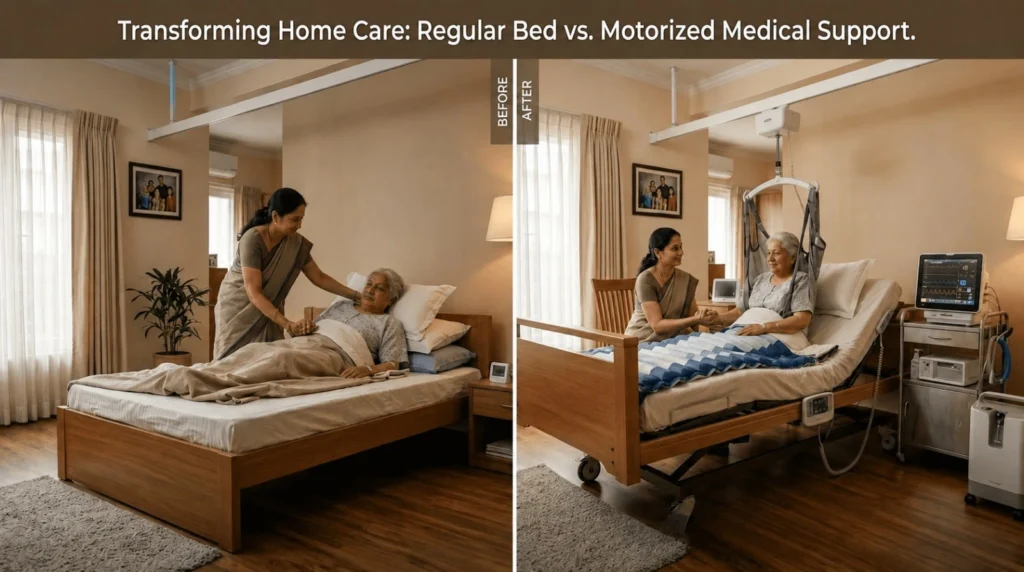
A common mistake Indian families make when setting up an ICU at home for a sick elderly parent is simply placing them on their favourite, comfortable old woode…A common mistake Indian families make when setting up an ICU at home for a sick elderly parent is simply placing them on their favourite, comfortable old wooden double bed. We naturally think the familiarity of their own bedroom mattress will help them heal faster and feel happier. However, for a patient who is completely bedridden after a severe stroke, major orthopaedic surgery, or general extreme weakness, a regular flat bed is actually a massive hidden medical hazard.
Why is caring for a bedridden parent at home so physically punishing for the family?
Indian households run heavily on deep family devotion. Daughters, sons, and spouses naturally take on the heavy daily duty of bathing the patient, changing their adult diapers, and feeding them softly. On a normal low-height bed, the caregiver has to constantly bend over at an awkward, unnatural angle. Within just a few short weeks, this leads to severe lower back pain and absolute physical burnout for the family member. Furthermore, when you try to gently prop the patient up with four or five soft pillows so they can drink soup, they inevitably slide down the mattress, which can easily cause them to accidentally choke on their food or aspirate fluids into their lungs.
The essential medical solution is a fully motorized 3-function hospital bed. This advanced equipment allows the patient or caregiver to elevate the backrest electronically with a simple, easy-to-use remote control, creating a perfectly safe, upright angle for meals and easier chest breathing. It also elevates the knees slightly upward, acting as a natural physical brake to stop the patient from sliding down toward the footboard. Furthermore, the entire bed frame can be raised to the caregiver’s waist height, allowing nurses and family to change clothes and diapers without ever bending their backs.
Will a motorized hospital bed actually fit inside a standard Indian apartment bedroom?
Yes, they are specifically designed to fit into standard residential rooms. However, delivery technicians carefully evaluate your door frames and elevator space during the assessment to ensure a smooth, damage-free installation. Once it is in place, the difference it makes — for both the patient’s safety and the caregiver’s back — is immediate.
Managing a critically ill patient at home means coordinating medicines, equipment, nursing, and consumables — often from multiple unreliable vendors. Hospit eliminates that burden entirely. From same-day medical equipment delivery and rental to pharmacy, nursing, caretaker support, and Comprehensive Geriatric Assessment — everything comes from one number, one team, and one invoice. Call us or WhatsApp us today to tell us what your loved one needs.
What is the biggest hidden danger of keeping a bedridden patient on a regular home mattress?
The absolute biggest threat of keeping a patient on a regular cotton or spring mattress is something hospitals call pressure ulcers, which are more commonly known as bedsores. When a physically weak patient lies in the exact same position for more than a few hours, the constant heavy body pressure blocks the microscopic blood flow to the skin around their heels, tailbone, elbows, and shoulders. Because the skin gets no oxygen, it quickly breaks down into extremely painful, deep open wounds that are incredibly difficult to heal and very easily get infected.
To completely prevent this dangerous condition, doctors strongly prescribe the use of an alternating pressure air mattress. This specialised medical device sits directly on top of the motorized hospital bed. It consists of hollow plastic air tubes connected to a very quiet electric pump. The pump constantly inflates and deflates alternating sections of the mattress all day and night. This gentle, invisible rolling motion continuously shifts the heavy pressure points on the patient’s body, ensuring that fresh blood circulates perfectly to every inch of their skin, even if they are paralysed and cannot turn themselves over.
What happens to the motorized bed if there is a sudden power cut?
The bed requires basic electricity to change its position. If the power goes out, the motors will safely lock, and the bed will remain strictly in its current position until the electricity is fully restored. This means there is no risk of the bed suddenly dropping or shifting — the patient stays exactly where they are until power returns.
Do I need to buy the medical air mattress separately from the hospital bed rental?
Yes, standard flat mattresses are generally not included in basic bed rentals. Because air mattresses deal directly with personal skin health and infection control, they must be purchased as an essential hygiene add-on. Think of it less as an optional extra and more as a non-negotiable part of safe home care for any bedridden patient.
You should not have to act as a hospital administrator while also being a son, daughter, or spouse. Hospit handles the medicines, the equipment, the nurses, the consumables, and the coordination — so you can focus on being present for your loved one. Tell us what your loved one needs and we will take it from there. Call us or WhatsApp us today.